Category: business

  • Executive Summary: Application Lifecycle in EAM

    #architecture #clarity #velocity #direction

    Das Application Lifecycle Management (ALM) in LeanIX ist ein zentraler Bestandteil des Enterprise Architecture Managements (EAM). Es ermöglicht Unternehmen, den gesamten Lebenszyklus ihrer Anwendungen effektiv zu verwalten und zu optimieren. Dieser Prozess umfasst alle Phasen von der Planung und Entwicklung über den Betrieb bis hin zur Ablösung von Applikationen.

    LeanIX bietet als EAM-Tool umfangreiche Funktionen, um Application Owner bei der Verwaltung ihrer Anwendungen zu unterstützen. Es ermöglicht eine ganzheitliche Sicht auf die IT-Landschaft und hilft dabei, Abhängigkeiten, Risiken und Optimierungspotenziale zu identifizieren.

    In diesem Blog werden wir zunächst die Bedeutung des ALM für Application Owner erläutern und anschließend konkrete Verbesserungsvorschläge für die Umsetzung in LeanIX präsentieren. Ziel ist es, die Effizienz und Effektivität des Application Lifecycle Managements zu steigern und somit einen größeren Mehrwert für das Unternehmen zu schaffen.

    Sensibilisierung der Application Owner

    Um Application Owner, die mehrere Applikationen verantworten und der Meinung sind, dass sie LeanIX nicht benötigen, von der Wichtigkeit von EAM im allgemeines und des Tools im besonderen zu überzeugen, können folgende Testfragen mit Fokus auf Architektur, Prozesse und Daten gestellt werden:

    a) Architektur-bezogene Fragen:

    • Wie schnell können Sie herausfinden, welche Ihrer Applikationen von einer geplanten Infrastrukturänderung betroffen wären?
    • Welche Ihrer Applikationen nutzen veraltete Technologien und müssen in naher Zukunft modernisiert werden?

    b) Prozess-bezogene Fragen:

    • Wie würden Sie den Einfluss einer Ihrer Applikationen auf die gesamte Wertschöpfungskette des Unternehmens beschreiben?
    • Bei einem Ausfall einer Ihrer Applikationen: Wie schnell können Sie alle betroffenen Geschäftsprozesse identifizieren?

    c) Daten-bezogene Fragen:

    • Können Sie für jede Ihrer Applikationen die verarbeiteten Datenentitäten und deren Datenflüsse skizzieren?
    • Können Sie ad hoc angeben, welche Ihrer Applikationen personenbezogene Daten verarbeiten und wie diese geschützt werden?

    d) Übergreifende Fragen:

    • Wie schnell können Sie bei einer Audit-Anfrage alle relevanten Informationen zu Ihren Applikationen zusammenstellen?
    • Wie stellen Sie sicher, dass alle Stakeholder stets über den aktuellen Stand und geplante Änderungen Ihrer Applikationen informiert sind?

    Verbesserungsvorschläge für Application Lifecycle Management in LeanIX

    Um Application Owner bei der Pflege ihrer Applikationen in LeanIX zu unterstützen, die Unternehmensarchitektur stärker am Business auszurichten und den Zusammenhang zum Datenmanagement zu nutzen, schlage ich folgende konkrete Aktivitäten als Diskussionsgrundlage vor:

    1. Schulungen und Workshops für Application Owner:
      • Organisieren Sie regelmäßige Schulungen zu LeanIX und Best Practices
      • Führen Sie Workshops durch, die den Zusammenhang zwischen Applikationen, Geschäftsprozessen und Daten verdeutlichen
      • Erstellen Sie praxisnahe Leitfäden und Checklisten für die Pflege von Applikationen in LeanIX in einem leicht zugänglichen Werkzeug wie z. B. Confluence
      • Erstellen Sie LeanIX-Surveys, über die Application Owner relevante Informationen einfach durch Beantwortung zugeschnittener Fragenkataloge vornehmen können
    2. Prozessorientierte Modellierung in LeanIX:
      • Implementieren Sie eine prozessorientierte Sicht in LeanIX
      • Verknüpfen Sie Applikationen mit den unterstützten Geschäftsprozessen
      • Visualisieren Sie den Beitrag jeder Applikation zur Wertschöpfungskette
    3. Integration von Datenmanagement-Aspekten:
      • Erweitern Sie das LeanIX-Metamodell um relevante Datenmanagement-Attribute
      • Verknüpfen Sie Applikationen mit den von ihnen verarbeiteten Datenentitäten
      • Implementieren Sie Datenflussdiagramme, die den Zusammenhang zwischen Applikationen und Daten zeigen
    4. Automatisierung und Integration:
      • Implementieren Sie Schnittstellen zwischen LeanIX und anderen relevanten Tools (z.B. BPM, Data Management Platform)
      • Automatisieren Sie die Aktualisierung von Basis-Informationen in LeanIX
      • Erstellen Sie Dashboards, die den Pflegestatus und die Datenqualität visualisieren
    5. Governance und Anreize:
      • Etablieren Sie klare Verantwortlichkeiten und SLAs für die Pflege von Applikationsinformationen
      • Implementieren Sie ein Belohnungssystem für Application Owner, die ihre Daten aktuell halten
      • Führen Sie regelmäßige Reviews der Applikationslandschaft durch
    6. Daten-Governance Integration:
      • Verknüpfen Sie Daten-Governance-Rollen (z.B. Data Owner, Data Steward) mit den entsprechenden Applikationen in LeanIX
      • Implementieren Sie Attribute für Datenklassifizierung und Datenschutzanforderungen bei Applikationen
      • Erstellen Sie Reports, die Daten-Governance-Aspekte über die gesamte Applikationslandschaft hinweg zeigen
    7. Kontinuierliche Verbesserung:
      • Etablieren Sie einen regelmäßigen Feedback-Prozess mit Application Ownern
      • Analysieren Sie Nutzungsmuster in LeanIX, um Verbesserungspotenziale zu identifizieren
      • Passen Sie das Metamodell und die Prozesse basierend auf dem Feedback kontinuierlich an
  • Will MBSE Benefit from Textual Notation?

    Model-Based Systems Engineering (MBSE) is evolving, and a key question arises: Will MBSE benefit from textual notation? The answer is a resounding yes, but it is not the whole story. Graphical representations and much more are still needed. Here’s why.

    Textual Notation as a Complementary Tool

    Textual notation is already a fundamental aspect of many basic modeling tools. Languages like PlantUML and Mermaid derive graphical representations from textual descriptions, making it easier for engineers to visualize their models. Similarly, domain-specific languages (DSLs) like Franca IDL being integrated into modeling tools like MagicDraw have proven effective. These tools allow users to either code or draw, integrating seamlessly with other model content, providing flexibility and ease of use.

    The Emergence of Two-Way Solutions

    Advanced tools are taking this integration further. For instance, sophisticated tools like MagicDraw now offer two-way translations between SysML v2 textual notation and graphical representations. This functionality allows for editing on both sides, akin to how markdown plugins work in VSCode. Such advancements are critical as they cater to both textual and graphical preferences, ensuring broader acceptance and usability.

    Bridging the Gap Between Coders and Modelers

    Textual notations are particularly appealing to those who are closer to coding. For coders, the familiarity of textual input can significantly lower the barrier to entry into the modeling world. Integrating textual notations into Integrated Development Environments (IDEs) where coding happens can streamline workflows and enhance productivity.

    However, for managers, architects, designers, and analysts, graphical representations, output management, and comprehensive lists consistent with models are crucial. Therefore, to effectively engage both technical and non-technical stakeholders, providing a combination of textual notations and corresponding graphical representations is essential.

    Addressing Broader Needs

    Reflecting on over a decade of experience in automotive projects, it is clear that MBSE must address a range of needs to be truly successful and widely accepted. Models must encompass various aspects such as cross-product, cross-solution, product solutions, functional modeling, system architecture, software architecture, and boardnet modeling.

    Additionally, the existing model content in UML and SysML v1 predominantly features graphical representations. Transitioning to textual notations won’t happen overnight. The need for tool integration is paramount. The enterprise environment is a complex network of tools for planning, requirements, system modeling, simulation, test management, and implementation. Tool content is often replicated between neighboring tools or linked, necessitating seamless integration.

    Machine-Readable Models and Analytics

    Models that are not machine-readable are essentially ineffective, serving only as “marketing” diagrams. Ensuring that models are machine-readable and providing model analytics, such as making model content available to tools like Tableau, is highly valued by business users.

    Conclusion

    In conclusion, textual representation like SysML v2 is foundational and will significantly benefit MBSE. However, it must complement diagramming and address other critical needs to be truly effective. The standards are in place, and now it’s time for the tool business to catch up. By embracing both textual and graphical representations, and addressing the diverse needs of stakeholders, MBSE can achieve greater acceptance and success.

  • Feature Lifecycle in Architecture

    #feature #lifecycle #tracing

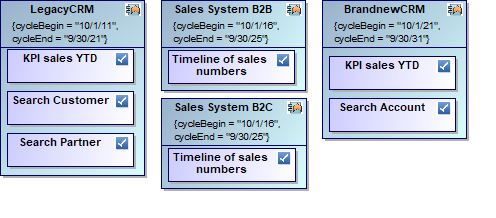
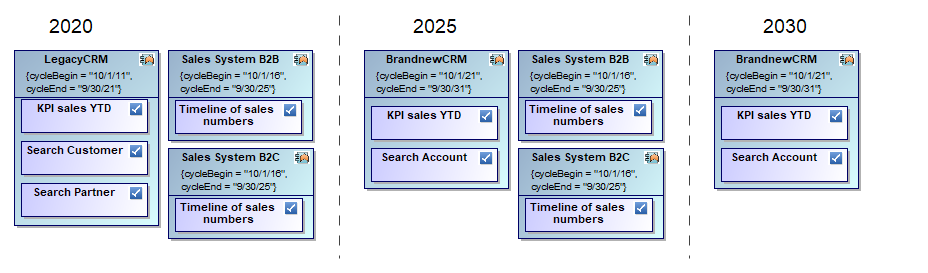
    When changing your application landscape on a bigger scale you might have to worry about a target architecture that you can only reach with intermediate steps like per year or release. Even a high-level roadmap may be rather complex due to necessary plan changes. The following reduced example shows the core problem:

    Feature Roadmap

    As you see, applications are repeated in different time windows and so are the features they provide. Moreover, feature provisioning may change like “Duplicate Check” might move from “LegacyCRM” to “BrandnewCMR”. In addition, features themselves may change like “Search Customer” and “Search Partner” being merged into “Search Account”.

    I see people doing these things in Excel and Visio or, even worse, in Powerpoint. And everytime my hair stands up expecting a lot of waste or worse like lost COVID-19 results. Excel is a powerful thing, no doubt, but it has its limits. The right way to do such an exercise is using a proper method with a proper tool set. There are many options like application lifecycle tools, enterprise architecture management tools, and modeling tools. I will explain the core concept using a modeling tool, but it can easily be translated to other tools.

    The core concept is based on adding the notion of lifecycle or time in general to your plan elements. Each gets a begin and end date between which it is valid. Consequently, showing an application being valid from 2018 to 2022 in a plan scenario for 2025 is not valid because it is long gone. But, since applications and also features typically live for many years, we can save a lot of redundancy by reusing the same elements wherever valid which also drastically improves consistency of your plan.

    Now, you can understand much better how we build the diagram from above. In fact, our database contains less elements and relations than you count on the diagram since we simply reuse them where valid.

    Plan Elements

    You may already guess the drastic improvement you can achieve in your very probably much larger scenario. It’s getting even better because we are now able to improve data quality with data validation as well as Powerpoint slides and Excel sheets by simply getting those as results of reports. We can even transfer plan data from and to other tools if necessary like for requirements management or budget planning.

  • The Power of Feature Models

    #feature #modeling #tracing #portfolio

    In the following, we will have a look where feature models can help improving management of software development.

    Example for mapping features to apps

    Definition

    In software development, a feature model is a compact representation of all the products of the Software Product Line (SPL) in terms of “features”.

    source: Wikipedia

    There are many more sources on the subject, but this simple one will suffice here.

    Manage Development using Feature Models

    In software development features are mostly implemented by code. Your development process like e.g. Scrum typically focuses on people, communication, self-organizing teams, and a running system among other things. A Scrum team sprints its own way from stories to running code. A typical question popping up looking at the big picture is:

    “How can development be managed across teams and products?”

    Cascaded agile working models like SAFe and LeSS (Scrum of Scrums) argue that architecture plays an important role and at the same time needs to be aligned with the code. How can you scale architecture from product code to product portfolio?

    Scaling Architecture from Products to Portfolio

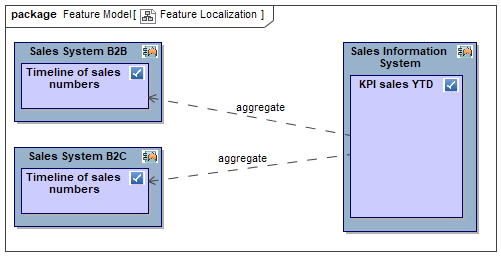
    Imagine you need to report a KPI for sales YTD based on weekly and daily sales data from various sales apps having different sales models. Three different app teams might be involved probably using different technologies and documentation. How do we get to a common denominator helping to organize development?

    First, let’s understand the business logic regardless of technologies. The feature “KPI sales YTD” itself is agnostic of sources delivering the raw data. It provides a unified concept into which some magic transforms the feature “Timeline of sales numbers” from sources B2C and B2B.

    Having identified those features we can now organize development. The app “Sales Information System” is responsible for calculating the KPI sales YTD while the apps “Sales System B2C” and “Sales System B2B” each manage timelines of sales numbers. Development effort can now be partitioned for the teams and dependencies are known too.

    The central idea here is to find a common concept for both products and portfolio. For those managing across products and teams features are used as basic units while app teams refine those to their specific needs.

    If you need more precision e.g. in the case that the aggregation of the timelines needs to be done in several steps like export timeline, enrich timeline, and sum up timeline you can cascade features. There are good approaches refining a feature model using e.g. business functions or business data or a combination of both.

    Conclusion

    Breaking products down into features has a lot of benefits

    • Speak a common language (portfolio and products)
    • Avoid double work (deduplicate feature implementation)
    • Avoid overall waste (streamlined feature catalogue)
    • Make progress transparent (plan per feature)
    • Ease analysis (impact per feature)
    • Clearly specify changes (story per feature change)

    Feature models support improvement of software development especially in case of self-organizing product teams.